
n8n vs Zapier vs Make for AI Workflows – Which Platform Actually Wins in 2026?

Discover fresh insights and innovative ideas by exploring our blog,  where we share creative perspectives

n8n vs Zapier vs Make for AI Workflows – Which Platform Actually Wins in 2026?
May 21, 2026
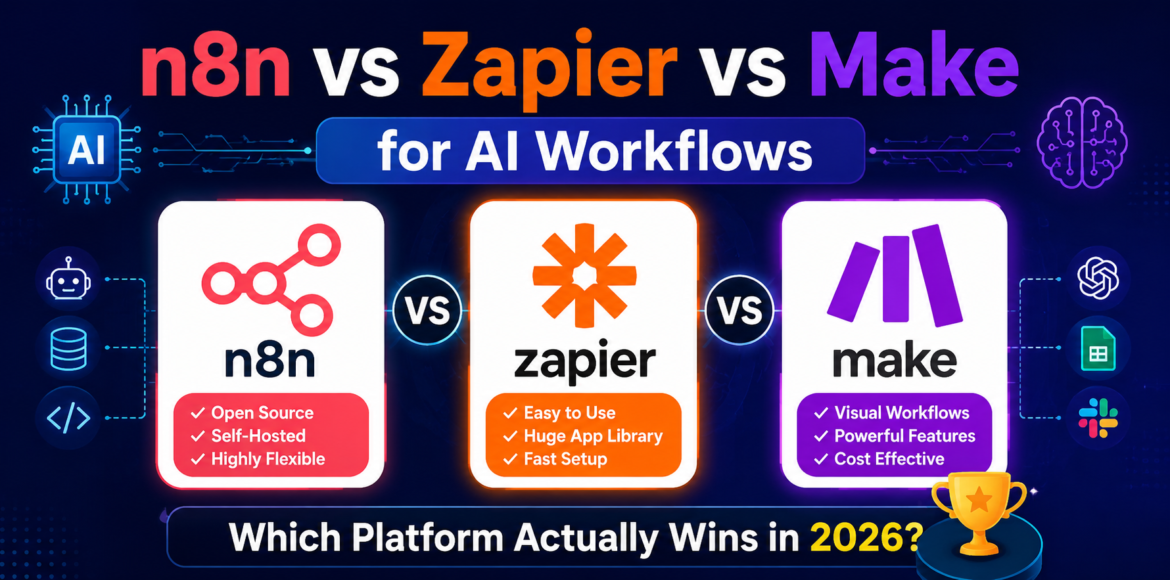
n8n vs Zapier vs Make for AI Workflows - Which Platform Actually Wins in 2026

You’ve decided to build AI-powered workflows for your business. Great. Now comes the part that trips up most teams: choosing the automation platform that will actually support what you’re trying to build — without hitting a wall at step three.

Zapier is the name everyone knows. Make is the favourite of power users. And n8n has quietly become the go-to for serious AI workflow automation without the per-task pricing shock. But which one is right for running AI agents, connecting LLMs to real business systems, and scaling without the bill exploding?

This guide cuts through the noise. We’ll compare n8n vs Zapier vs Make for AI workflows across the dimensions that matter most — pricing, flexibility, AI-native capabilities, integration depth, and enterprise scalability so you can make a decision backed by facts, not hype.

By the end, you’ll know exactly which platform fits your use case, your budget, and your growth trajectory.

What Are These Automation Platforms and Why Does the Choice Matter for AI?

At their core, Zapier, Make, and n8n are workflow automation platforms: tools that connect apps, trigger actions, and move data between systems without requiring you to write custom code for every integration. A Zap, a Scenario, or an n8n Workflow does the same basic job — but the architecture underneath each one is radically different.

That difference becomes critical the moment AI enters the equation.

Running an AI voice agent or an LLM-powered chatbot isn’t just connecting two SaaS apps. It means handling asynchronous API calls, managing conversation state, routing conditional logic based on model output, passing structured JSON between nodes, and often looping back on outputs. Traditional no-code platforms were built for linear, event-driven tasks like “when a form is submitted, add a row to Google Sheets.” AI workflows are far more dynamic.

According to a 2024 report by McKinsey, 72% of companies have adopted AI in at least one business function — and the majority of implementation bottlenecks are operational, not algorithmic. The platform you choose determines how fast you can move.

AI workflow automation services

This is the lens through which this comparison is built: not which platform has the most app integrations, but which one gives you the most control, speed, and scalability when building AI-powered systems.

Pricing Breakdown: Where Each Platform Gets Expensive Fast

Pricing is where the differences become immediately practical.

Zapier operates on a task-based pricing model. Every time an action runs in a Zap, it consumes a task. At the Professional tier (starting around $49/month), you get 2,000 tasks. Sounds reasonable — until your AI workflow runs 15 actions per trigger. One hundred customer interactions suddenly consumes 1,500 tasks. At enterprise scale, Zapier bills can climb past $600–$800/month before you’ve done anything extraordinary.

Make (formerly Integromat) is more generous. It prices by operations rather than tasks, and its visual scenario builder is genuinely powerful. The Core plan starts at $9/month for 10,000 operations. For moderate AI workloads, Make can be significantly cheaper than Zapier. However, complex AI loops — where a workflow calls an LLM, evaluates the output, and branches — can burn operations quickly due to the way iterators and routers are counted.

n8n breaks the model entirely. The self-hosted version is free and open-source. You run it on your own infrastructure (a $5–$10/month VPS is sufficient for many workloads), and you pay zero per-execution fees. The cloud version starts at $20/month for individuals and $50/month for teams — but critically, there are no execution limits on most plans. For AI workflows that run thousands of times per day, this is game-changing.

For teams building AI agents at scale, n8n’s pricing model is frequently 70–90% cheaper than Zapier at equivalent workload volumes.

n8n – Pricing Plan 2026
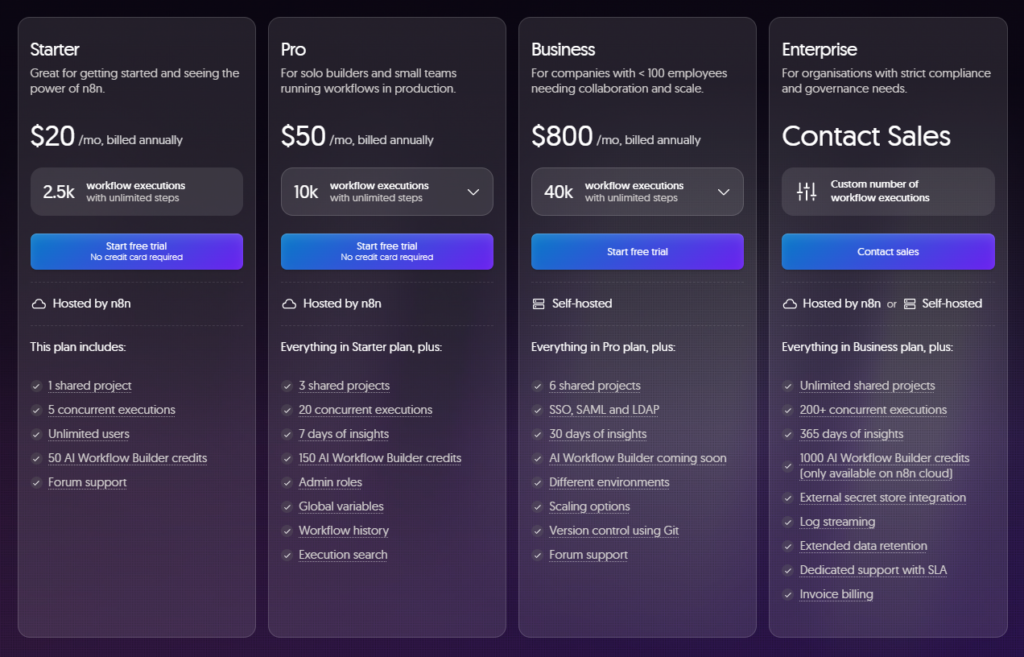
n8n pricing plan

AI-Native Capabilities: Which Platform Was Built for LLMs?

This is where the real separation happens.

Zapier has added AI features including OpenAI integrations and its own “AI by Zapier” actions but these feel bolted on rather than native. The platform was designed for linear automation, and the lack of true looping, branching-on-model-output, and stateful conversation handling shows when you try to push it. Zapier is excellent for simple AI augmentation (summarise an email, classify a support ticket) but struggles with multi-step AI agent orchestration.

Make offers more flexibility. Its visual canvas handles complex branching well, and you can connect to OpenAI, Anthropic, and other LLM APIs via HTTP modules. The iterator and aggregator system allows for processing arrays of data useful for batch AI jobs. However, Make lacks native AI agent nodes and debugging LLM chains visually can become genuinely messy as complexity grows.

n8n has invested most heavily in AI-native infrastructure. It ships with dedicated LangChain nodes, AI Agent nodes, vector store integrations (Pinecone, Qdrant, Supabase), memory nodes, and tool-calling nodes all built directly into the platform. You can build a conversational AI agent that retrieves from a knowledge base, calls external tools, maintains session memory, and falls back gracefully all within a single n8n workflow. No custom code required.

For teams building AI voice agents, CRM automation powered by LLMs, or intelligent customer support workflows, n8n’s native AI stack reduces build time dramatically.
Build Voice AI Agents

Integration Depth and Flexibility: No-Code vs. Full Control

All three platforms offer hundreds of pre-built integrations with popular SaaS tools Slack, HubSpot, Salesforce, Airtable, Google Workspace, and more. But the way they handle custom integrations reveals their true flexibility ceiling.

Zapier has the largest app library over 7,000 integrations which makes it excellent for connecting well-known consumer and SMB tools. However, custom HTTP requests and complex API configurations are harder to manage. When an API requires custom authentication flows, dynamic headers, or pagination handling, Zapier’s rigid structure can become a serious constraint.

Make handles custom HTTP calls well. Its HTTP module is flexible, and the visual debugger makes it easier to see where API requests fail. For mid-complexity integrations, Make strikes a good balance between visual simplicity and technical depth.

n8n gives you the most control. Every node exposes full HTTP configuration, and you can drop into JavaScript or Python code nodes at any point in a workflow without switching tools. This matters enormously for AI workflows that need to parse non-standard API responses, transform data mid-chain, or call internal microservices. n8n also supports webhooks, queue-based triggers, and custom node development making it the most extensible of the three.

For businesses that need to connect AI workflows to proprietary internal systems, legacy CRMs, or bespoke APIs, n8n is the only platform that won’t eventually require a workaround.

Real-World Use Cases: Which Platform Fits Which Scenario?

The right choice often depends on what you’re actually building. Here’s how each platform performs across common AI automation use cases:

Customer Support Automation:

Zapier works for simple ticket routing. Make handles moderate complexity with its routing modules. n8n excels here you can build a full support AI agent that reads incoming tickets, queries a knowledge base, drafts a response via GPT-4 or Claude, routes to a human agent when confidence is low, and logs everything to your CRM. The entire chain runs in one workflow with no execution limits.

AI Voice Agent Workflows:

Voice agent pipelines require fast, reliable webhook handling and multi-step post-call processing (transcription → intent extraction → CRM update → follow-up scheduling). n8n handles this natively and can be self-hosted for lower latency. Zapier and Make can handle parts of this chain, but multi-step voice post-processing becomes expensive and fragile on task-based pricing models.

Lead Qualification and CRM Automation:

All three platforms can sync leads from web forms to CRMs. But if you want an AI agent to score leads, enrich them via an external API, and personalise outreach based on company data n8n and Make both handle this well. Zapier hits its ceiling faster on complex conditional logic.

E-commerce and Order Management:

For standard order-to-fulfilment pipelines without heavy AI involvement, Make and Zapier are faster to set up due to their native Shopify, WooCommerce, and Stripe integrations.

Healthcare and Appointment Booking:

HIPAA-adjacent workflows often require self-hosted infrastructure for data residency compliance. n8n’s self-hosted option makes it the only viable choice among these three for healthcare organisations with strict data governance requirements.

How to Choose the Right Automation Platform for Your AI Stack

Choosing between n8n vs Zapier vs Make for AI workflows isn’t about which is “best” in the abstract. It’s about matching the platform to your specific constraints.

Choose Zapier if your team is non-technical, your workflows are simple (under 5 steps), and you’re connecting mainstream SaaS tools without AI complexity. It’s fast to set up and the easiest to hand off to a non-developer.

Choose Make if you want visual power-user features, moderate pricing, and are building workflows of medium complexity particularly for marketing automation, data transformation, or multi-branch business logic without heavy AI agent orchestration.

Choose n8n if you are building AI-powered workflows at any meaningful scale especially AI agents, voice automation, LLM chains, or systems that need to run thousands of executions per day. The combination of open-source licensing, native AI nodes, self-hosting flexibility, and unlimited executions makes it the strongest foundation for serious AI automation work.

One critical consideration: whoever builds your automation stack matters as much as which platform you choose. A poorly structured n8n workflow is just as brittle as a poorly structured Zap. The real competitive advantage comes from working with a team that understands both the technical architecture and the business outcomes you’re chasing.

Common Mistakes to Avoid When Comparing These Platforms

Teams evaluating automation platforms for AI agents frequently fall into the same traps.

Optimising for app count, not workflow depth. Zapier’s 7,000+ integrations sound impressive. But if 6,800 of them don’t apply to your stack, a more flexible platform with fewer pre-built connectors and better custom HTTP support wins every time.

Ignoring execution pricing at scale. A workflow that runs 50 times a day during a pilot becomes 50,000 times a day in production. Model your actual costs at projected volume not at the free tier. Many teams switch platforms 12 months in precisely because they didn’t run this number early.

Underestimating debugging complexity. When an AI agent produces unexpected output, you need to trace exactly what happened at each node. n8n’s execution inspector and Make’s scenario debugger both handle this reasonably well. Zapier’s debugging tooling is the weakest of the three.

Treating the platform as a final commitment. The best teams build workflows with clean, documented logic that can be migrated if needed. Platform lock-in is real but manageable if your business logic isn’t buried inside platform-specific feature implementations.

At Barq Digital AI, we’ve helped businesses across healthcare, real estate, and e-commerce navigate exactly these decisions selecting the right stack, building workflows that scale, and avoiding the expensive mistakes that come from choosing a platform for the wrong reasons.

Frequently Asked Questions

Is n8n better than Zapier for AI workflows?

For most AI workflow use cases especially those involving LLMs, AI agents, or high execution volumes n8n is the stronger choice. It offers native LangChain and AI agent nodes, no per-execution pricing, and self-hosting flexibility. Zapier is easier to start with but hits performance and cost ceilings faster when AI complexity increases.

What is the best automation platform for AI agents in 2026?

The best automation platform for AI agents in 2026 depends on your scale and technical requirements. n8n leads for developers and technical teams building complex AI pipelines. Make is a strong mid-tier option. Zapier remains the easiest entry point for simple, AI-augmented tasks without agent orchestration.

Can Make.com handle LLM-powered workflows?

Yes, Make can connect to OpenAI, Anthropic, and other LLM APIs through its HTTP module and official OpenAI integration. However, it lacks native agent nodes, vector store connections, and memory management that n8n provides out of the box. For basic LLM tasks like text generation or classification, Make works well. For agentic AI workflows, n8n is more capable.

Is n8n free to use for business automation?

n8n’s self-hosted version is free and open-source under the Sustainable Use License. You pay only for the infrastructure to run it (typically $5–$20/month on a VPS). The cloud-hosted n8n starts at $20/month with no execution limits on most plans making it dramatically more cost-effective than Zapier or Make at scale.

Which automation tool is best for CRM integration with AI?

All three platforms integrate with major CRMs like HubSpot, Salesforce, and Pipedrive. For basic sync and automation, any of the three will work. For AI-enriched CRM workflows where a model scores leads, generates personalised messages, or updates records based on conversation outcomes n8n offers the most control and the most native AI tooling.

Conclusion

The debate around n8n vs Zapier vs Make for AI workflows ultimately comes down to this: Zapier is for getting started fast, Make is for visual power users on a budget, and n8n is for teams serious about building scalable, AI-native automation infrastructure.

If your business is moving toward AI agents, voice automation, or LLM-powered operations, the platform you choose now will either accelerate or constrain everything you build next. Choose based on where you’re going not just where you are today.

The right automation stack, built correctly, is one of the highest-leverage investments a growing business can make.

Leave A Comment

Cart (0 items)