
How Smart Companies Are Scaling Business Automation Without Adding Headcount

Every operations manager knows the feeling: your team is capable, motivated, and smart, yet they spend hours every week on tasks a machine could handle in minutes. Data entry. Follow-up emails. Invoice routing. Report generation. Status updates. The list is endless.
It’s not a people problem. It’s a systems problem.
Business process automation services exist to solve exactly this. By applying AI, workflow automation tools, and intelligent process automation to repetitive business tasks, companies are reclaiming dozens of hours per week without hiring more staff.
In this article, you’ll learn what business process automation actually involves, why forward-thinking companies are adopting it now, the specific benefits it delivers, real-world use cases across industries, and how to choose the right automation partner for your business.
What Are Business Process Automation Services and How Do They Work?
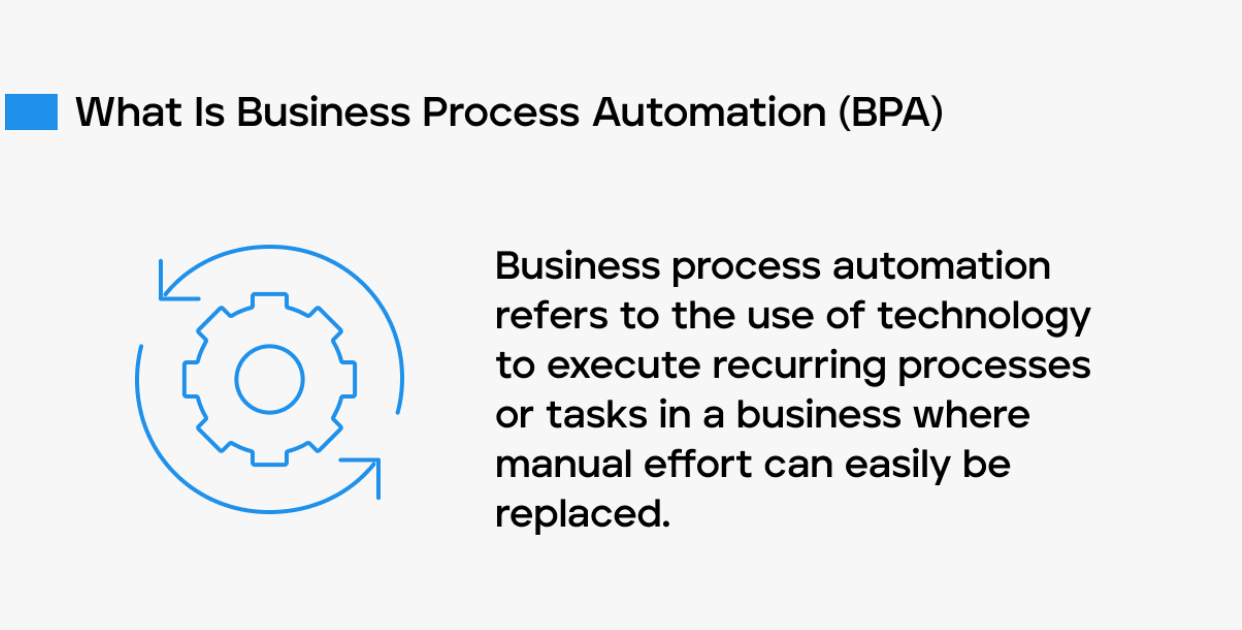
Business process automation (BPA) refers to using technology to execute recurring tasks or processes in a business where manual effort can be replaced by automated systems. It goes well beyond basic task scheduling. Modern BPA combines AI workflow automation, rule-based logic, system integrations, and increasingly, large language models to handle complex, multi-step processes.
Think of it as building a digital workforce layer beneath your human team. A workflow automation system might automatically pull a new lead from your website form, enrich that record with external data, score it based on predefined criteria, assign it to the right sales rep, send a personalized follow-up email, and log everything in your CRM all within seconds of the form being submitted, with zero human involvement.
The technology stack behind BPA typically includes robotic process automation (RPA) for rule-based repetitive tasks, intelligent process automation (IPA) when AI judgment is involved, API integrations that connect disparate software systems, and workflow management systems that orchestrate the sequence of steps.
According to McKinsey, roughly 60% of all occupations have at least 30% of their activities that could be automated with current technology.

Why Businesses Are Investing in Process Automation Right Now
The business case for automation has never been stronger, and several converging forces are pushing companies to act now rather than wait.
First, labor costs continue to rise. Hiring, training, and retaining staff for repetitive operational roles is expensive and increasingly difficult. AI business automation services provide a scalable alternative that works 24/7 without burnout, sick days, or turnover.
Second, the technology has matured. Five years ago, setting up meaningful automation required significant technical resources and custom development. Today, a capable automation consulting services partner can deploy production-ready workflow systems in weeks using modern no-code and low-code platforms, combined with custom AI layers.
Third, competitive pressure is real. Businesses that automate routine operations move faster, respond to customers sooner, and operate at lower cost per transaction. In industries like e-commerce, real estate, and healthcare, even a 20% reduction in manual processing time translates directly into margin and customer satisfaction gains.
A 2023 Salesforce report found that 67% of IT leaders say automation is critical to digital transformation efforts.
Key Benefits of Business Process Automation Services
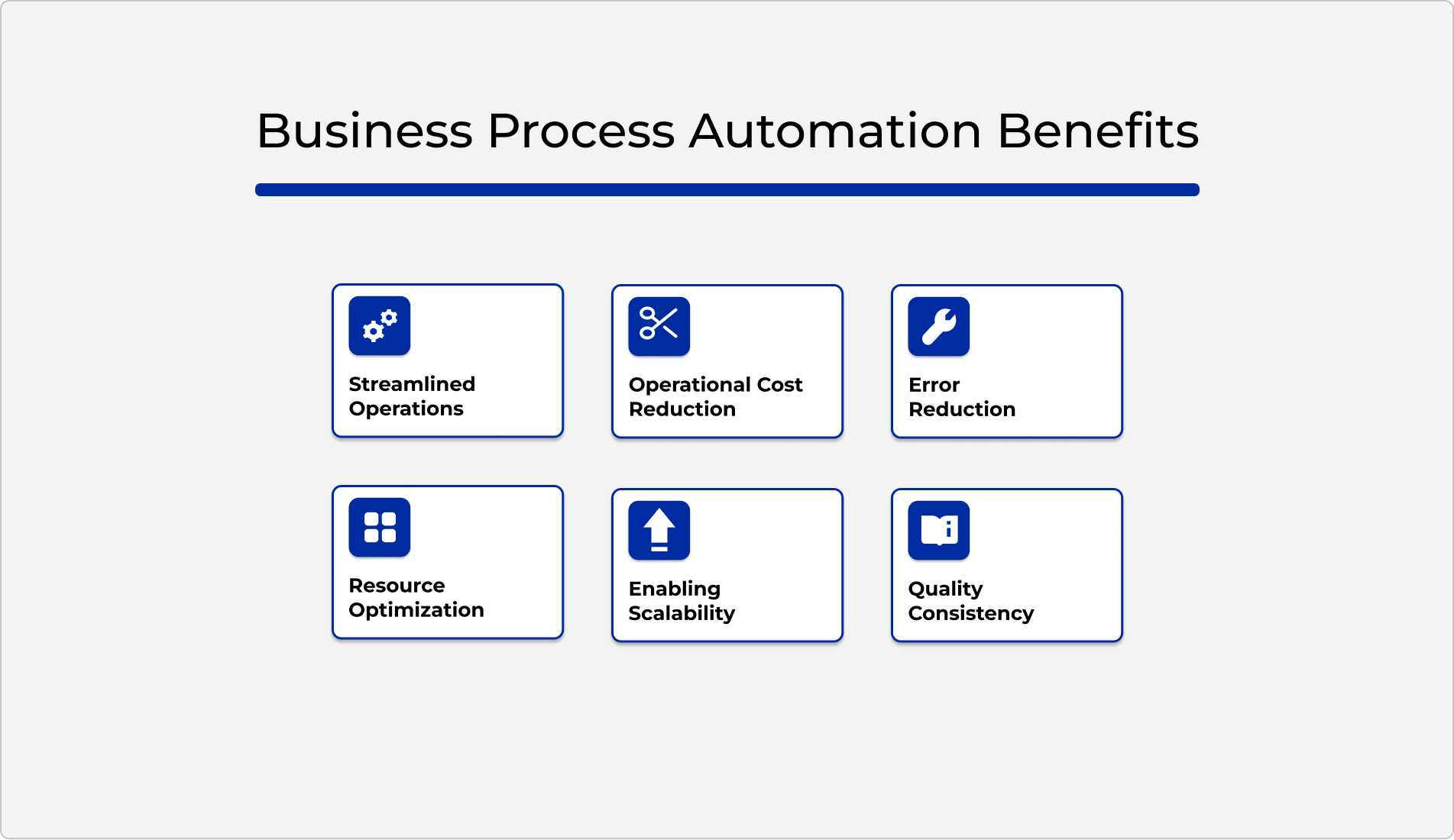
The benefits of business process workflow automation are measurable, not theoretical. Here’s what businesses consistently see after implementing structured automation:
- Time reclaimed at scale: Processes that took 3–5 hours manually are completed in minutes. Teams handling 200 tasks/week can redirect 40–60% of that capacity to higher-value work.
- Error reduction: Manual data handling introduces errors at an average rate of 1–5% per task. Automated workflows execute the same logic perfectly every time.
- Faster customer response times: Automated intake, routing, and response systems can cut first-response time from hours to under 2 minutes a major driver of customer satisfaction.
- Cost efficiency: According to Deloitte’s Global RPA Survey, organizations implementing RPA saw an average cost reduction of 22% in the functions they automated.
- Scalability without headcount: Automation allows a team of 10 to handle the operational load of 30, without proportional payroll growth.
- Audit trails and compliance: Every automated action is logged, timestamped, and traceable critical for regulated industries like healthcare and finance.
The ROI compounds over time. Unlike a new hire whose productivity plateaus, an automated system can be continuously refined and extended.
Real-World Use Cases Across Industries
Business process automation services for small businesses and enterprise teams alike share one thing: the use cases are almost always in the same categories, just at different volumes.
E-commerce and retail: Order processing, inventory updates, returns management, and customer notification workflows. An e-commerce brand processing 500+ orders/day can automate fulfillment notifications, low-stock alerts, and supplier reorder triggers reducing ops team workload by 40%.
Real estate: Lead capture from listing platforms, automatic CRM entry, appointment scheduling with AI voice agents, and follow-up nurture sequences. Agents reclaim 10+ hours per week previously spent on administrative coordination.
Healthcare: Patient intake forms, appointment reminders, insurance verification workflows, and internal referral routing. Clinics using digital process automation report 30–50% reduction in front-desk administrative load.
Professional services and B2B: Proposal generation, contract routing for signatures, invoice processing, and client onboarding workflows. Law firms and consultancies are increasingly using custom workflow automation services to systematize client delivery.
Startups: AI workflow automation solutions for startups are particularly high-value because early-stage teams can’t afford to scale headcount fast. Automation allows a 5-person team to operate with the efficiency of a 15-person team.
How to Choose the Right Business Process Automation Partner
Not all automation consulting services are built the same. Selecting the wrong partner costs you time, money, and momentum. Here’s what to evaluate:
Technical breadth: Your partner should be fluent across multiple automation platforms not locked into a single vendor. Whether you need RPA tools, AI-powered workflow systems, or custom API integrations, they should guide you to the right fit for your use case, not the tool they happen to sell.
Industry experience: Automation that works in SaaS doesn’t automatically translate to healthcare or manufacturing. Look for demonstrated experience in your vertical with real case studies, not just generic demos.
Integration capability: Modern businesses run on 10–20+ software tools. Your automation partner must be able to integrate your CRM, ERP, communication tools, and custom systems seamlessly. Ask specifically about their enterprise workflow automation and integration track record.
AI-first approach: The best process automation solutions today aren’t purely rule-based they incorporate AI to handle exceptions, extract meaning from unstructured data, and improve over time. Partners still selling pure RPA without an AI layer are selling yesterday’s solution.
Ongoing support and iteration: Automation is not a one-time project. Processes change, systems update, and business needs evolve. Choose a partner who offers continuous refinement, not just a handoff.
At Barq Digital AI, we approach every automation engagement by mapping your actual business processes first before recommending a single tool. This process-first methodology is what separates durable automation from expensive experiments that collect dust.
Common Mistakes Businesses Make with Process Automation
Even well-intentioned automation projects fail. Here are the patterns that sink them:
Automating broken processes: If a manual workflow is inefficient or poorly designed, automating it makes the inefficiency faster not better. Always optimize the process logic before automating it.
Underestimating integration complexity: Most businesses underestimate how long it takes to connect legacy systems, manage API rate limits, and handle edge cases. Budget for this realistically.
Skipping change management: Automation affects how people work. Teams that aren’t trained on new workflows or don’t understand why changes are happening resist adoption and workarounds break the system.
Choosing tools before understanding needs: Many businesses get sold on a popular process automation software platform and then try to fit their problems into it. The right approach is requirements-first, tools-second.
No measurement framework: If you don’t define success metrics before you start hours saved, error rates, processing time you can’t prove ROI or know where to improve.
One insight from working with dozens of automation clients: the businesses that see the fastest time-to-value are those who start with one high-volume, well-defined process rather than trying to automate everything at once. Small wins build organizational confidence for larger transformations.
How Barq Digital AI Delivers Business Process Automation
At Barq Digital AI, our AI business automation services are built around one principle: automation should create measurable, lasting value not just technical novelty.
Our approach combines AI voice agents for front-line customer interaction, conversational AI chatbots for async support and intake, and deep workflow automation services that connect your entire operational stack. Whether you’re a startup looking to automate business processes with AI tools for the first time, or an established business ready for enterprise-grade workflow transformation, we build systems that fit your operations not generic templates.
We’ve helped businesses in real estate, healthcare, e-commerce, and professional services reduce manual workload by 40–70%, improve response times from hours to minutes, and scale their operations without proportional headcount growth.
Our team handles everything from process mapping and system integration to AI model configuration, testing, and ongoing optimization. You don’t need an in-house technical team. You need a partner who understands both the technology and your business.
Frequently Asked Questions
What is business process automation and how is it different from RPA?
Business process automation (BPA) is a broad term for using technology to automate multi-step business workflows. Robotic process automation (RPA) is a specific type of BPA that uses software bots to mimic human actions in digital interfaces (like clicking, copying, and pasting data). Modern BPA often combines RPA with AI capabilities sometimes called intelligent process automation (IPA) to handle more complex, judgment-based tasks.
How much do business process automation services cost?
Costs vary significantly based on complexity. Simple single-process automations can cost $2,000–$10,000 to implement. Full enterprise workflow automation engagements covering multiple departments and system integrations can range from $20,000–$100,000+. Most businesses see full ROI within 6–18 months. A quality automation consulting services partner will always provide a clear ROI model before you commit.
Are business process automation services suitable for small businesses?
Absolutely. In fact, business process automation services for small businesses often deliver the highest proportional ROI because small teams feel the impact of time savings most acutely. AI workflow automation solutions for startups and small businesses are now more accessible than ever, with implementation timelines as short as 2–4 weeks for targeted workflows.
What business processes are best suited for automation?
The best candidates for workflow automation services are processes that are: high-volume and repetitive, rule-based with clear logic, prone to human error, time-sensitive, or involve data transfer between multiple systems. Common starting points include lead management, invoice processing, customer onboarding, appointment scheduling, and internal approval workflows.
How long does it take to implement business process automation?
Timeline depends on scope. A focused automation for a single process like automating lead follow-up or invoice routing can be live in 2–4 weeks. Broader digital process automation engagements covering multiple departments typically take 8–16 weeks from scoping to full deployment. A phased approach, starting with one high-impact process, is usually the fastest path to measurable results.
Conclusion
Business process automation services have moved from competitive advantage to operational necessity. Companies that continue relying on manual workflows for tasks that can be automated are paying a compounding cost in time, money, errors, and missed growth.
The good news is that getting started doesn’t require a full company transformation. It requires a clear starting point, the right automation partner, and a commitment to measuring results.
If your team is spending time on work that should be running on autopilot, it’s time to change that.
Ready to automate your business processes with AI? Book a free strategy call with Barq Digital today and get a custom roadmap for your first (or next) automation project.